 Trapol8
Collecting the answers is the easy part. Knowing which ones changed is the job.
Trapol8 Ask builds and sends your due diligence questionnaires. Then, AI reads every response that comes back: what changed since last cycle, what got answered around, and what doesn't look like the rest of your manager set.
SOC 2 Type 2 Certified · ILPA & AIMA SupportBuilt for Institutional Allocators & Investment Consultants
What is DDQ variance monitoring?
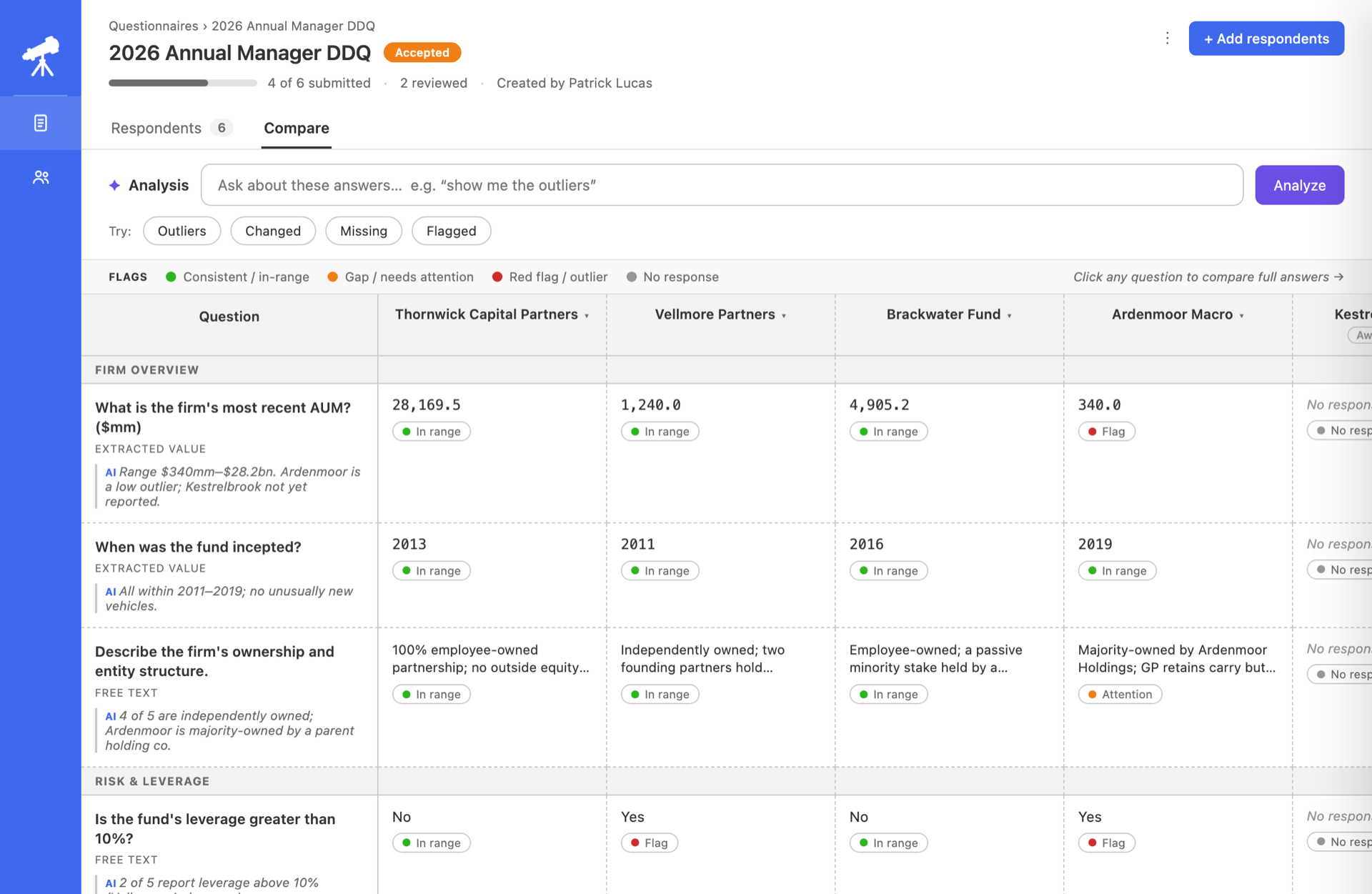
DDQ variance monitoring uses AI to compare due diligence questionnaire responses and surface the ones that deserve a second look. Forty managers answer the same hundred questions. Six of those answers are different from last cycle, two are not really answers, and one does not look like anybody else's. Finding those three used to be the review. Now it is where the review starts.


Answers that changed
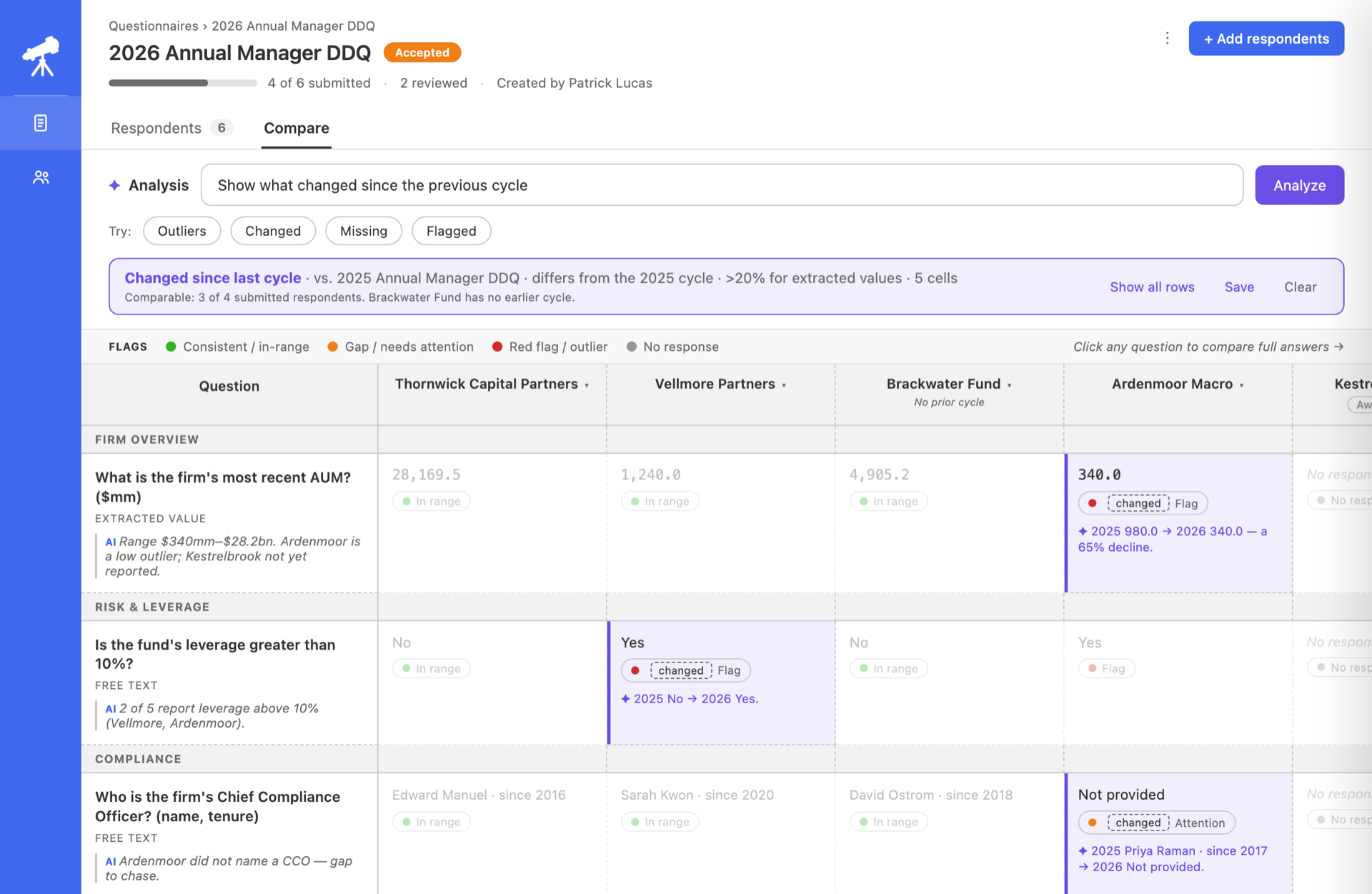
Trapol8 compares each response against what the same manager said last cycle and flags the differences: a shifted strategy description, a revised risk limit, a quietly reworded valuation policy.
Answers that aren't answers
Blanks are easy to spot. The harder cases are the questions answered around rather than answered. Trapol8 surfaces the hedges, the deflections, and the see-attached non-responses.
Outliers across the set
When every manager answers the same question, the interesting one is the answer that doesn't look like the others. Trapol8 identifies it instead of making you read for it.
Whatever you tell it to watch
Describe what matters to you in plain language: key-person language, fee terms, a valuation policy you've been tracking. Trapol8 watches incoming responses for it.
Where this shows up as risk
Variance monitoring doesn't make the risk judgment for you. What it changes is when you find things. A quietly reworded valuation policy is a signal whether or not anyone catches it, and in a manual read of forty questionnaires, that is exactly the kind of item that gets missed. Surfacing it inside the review cycle instead of after it is the difference between a follow-up call and a post-mortem.
We built the answering side first. Your managers can tell.
Trapol8 started as DDQ response software for asset managers. Those firms liked it enough to ask us to build the allocator side, so we did. Every other platform in this category started where you're sitting. We started where your managers are sitting, and it shows up in what lands back in your inbox.
Better answers
Managers responding through Trapol8 Answer draft from their own approved answer library, and every draft cites the source document behind it. What comes back to you is sourced and internally consistent, not improvised at 6pm on the deadline.
Faster answers
A questionnaire sent through Trapol8 arrives somewhere managers already know how to work. Less friction on their end means fewer reminder emails on yours, and responses that come back complete the first time.
Questions nobody's asking
Sitting on the responding side of thousands of questions shows you the gaps: what managers are never asked, and the questions everyone asks in a way that's easy to answer around. That insight goes into the questionnaires you build here.
And yes, it does the obvious things.
Building and sending questionnaires is not what makes a platform worth switching to. It is what makes one usable at all, and what makes the switch itself cheap. Trapol8 Ask does both, then gets out of the way.
Bring the questionnaire you already use.
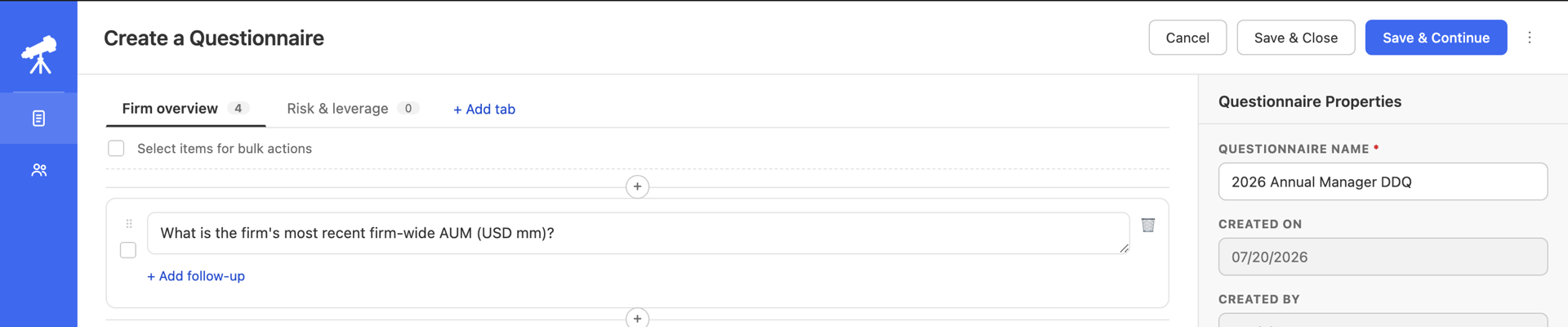
Most allocators arriving here are running DDQs out of Word, Excel, or a PDF attached to an email. None of it has to be rebuilt. Upload the blanks you send today and Trapol8 digitizes them. Same questions, same order, same wording, ready to distribute.
Create
Start from ILPA, AIMA, or your own question library. Add, cut, and reorder per manager type instead of rebuilding each questionnaire from scratch.
Distribute
Send to one manager or your full roster. Deadlines, reminders, and completion status live in one view rather than in your sent folder.
Collect
Responses arrive structured and comparable, not as forty differently formatted attachments you normalize by hand before the real work starts.
See what your manager set is actually telling you.
Book a 30-minute walkthrough of Trapol8 Ask, and spend most of it on the variance report, which is the part that matters.
Common questions from allocators and consultants.
What is DDQ variance monitoring?
DDQ variance monitoring uses AI to compare due diligence questionnaire responses and surface what deserves a second look. In Trapol8 Ask it flags answers that changed from a manager's previous response, surfaces questions that were answered evasively or not at all, and identifies outliers across a set of managers answering the same question. You can also tell the AI what to watch for in your own words, and it will monitor incoming responses for it.
How does variance monitoring help with risk?
Variance monitoring does not make a risk judgment for you. What it does is change when you find things. A quietly reworded valuation policy, or a key-person question answered around rather than answered, is a risk signal whether or not anyone notices it, and in a manual review of dozens of questionnaires those are exactly the items that get missed. Trapol8 Ask surfaces them during the review cycle rather than after it, which is the difference between following up with a manager and finding out later.
What is Trapol8 Ask?
Trapol8 Ask is the allocator side of the Trapol8 platform. It lets institutional allocators and investment consultants create due diligence questionnaires, distribute them to asset managers, track and manage the responses that come back, and analyze those responses with AI variance monitoring. It is the counterpart to Trapol8 Answer, which asset managers use to respond to DDQs.
Why does it matter that Trapol8 started on the manager side?
Trapol8 built DDQ response software for asset managers before building the allocator side, and that shows up in what comes back. Managers responding through Trapol8 Answer draft from their own approved answer library, with every draft citing the source document behind it, so responses arrive sourced rather than improvised. They also arrive faster, because the platform was designed around how responding teams actually work. Sitting on the responding side of thousands of questions also gives us unusual visibility into what allocators tend not to ask.
Can I use my own questionnaire, or do I have to use a template?
You can use your own. Trapol8 Ask supports custom questionnaires as well as standard industry templates such as ILPA and AIMA. If you currently run DDQs out of Word, Excel, or a PDF sent by email, you do not have to rebuild them. Upload the blank questionnaires you send today and Trapol8 digitizes them, keeping your questions, their order, and their wording intact. Most firms start from either their existing document or a standard template, then add to it.
Who is Trapol8 Ask built for?
Trapol8 Ask is built for institutional allocators and investment consultants who send due diligence questionnaires to asset managers: pensions, endowments, foundations, family offices, funds of funds, OCIOs, and the consultants who advise them. Anyone running manager due diligence across more than a handful of managers, on more than a one-off basis, is the intended user.
Is my data secure with Trapol8?
Yes. Your data never trains AI models, it stays in your account, and it's only accessible to users on your team. Trapol8 is SOC 2 Type 2 certified.